New TSA option coming February 1 for guests traveling without REAL ID compliant identification

Summary

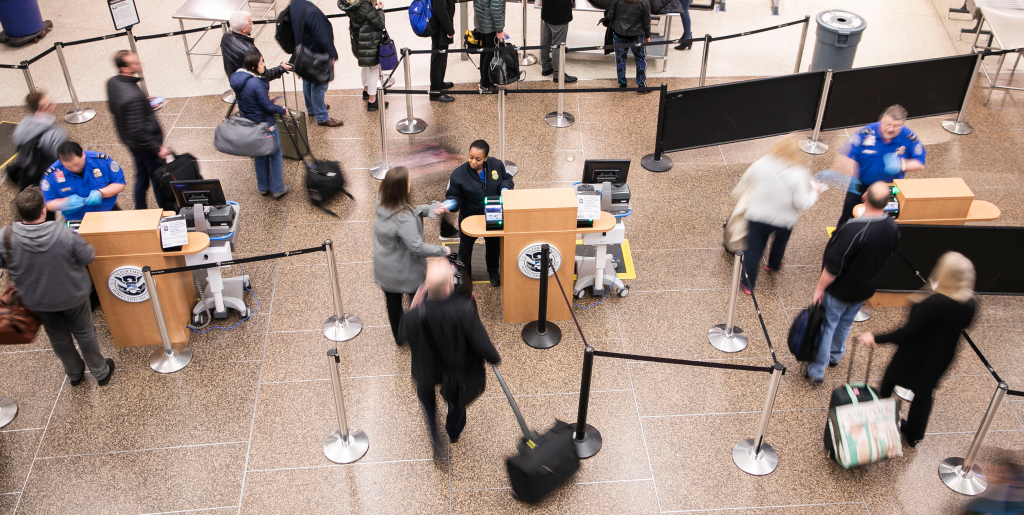
To date, travelers attempting to fly without a REAL ID have been delayed or possibly denied entry through TSA checkpoints. 

Starting February 1, the TSA is instituting a new, fee-based identity verification tool that can be used by anyone needing to fly without a REAL ID.

The tool, titled TSA ConfirmID, has a mandatory fee of $45 for each verification and can be used to verify your identity in advance. 

Since last spring, every air traveler 18 years of age and older has required a REAL ID-compliant driver’s license, state-issued enhanced driver’s license, or another acceptable form to fly within the United States. 

To date, travelers attempting to fly without a REAL ID have been delayed or possibly denied entry through TSA checkpoints. Starting February 1, the TSA is instituting a new, fee-based identity verification tool that can be used by anyone attempting to fly without a REAL ID.   

The tool, titled TSA ConfirmID, can be found via QR code on posted signage at the airport, or directly through tsa.gov. ConfirmID has a mandatory fee of $45 for each verification, which can only be paid digitally and can take 30 minutes or more to process. Verification through the tool can be performed in advance and is valid for 10 days; travel beyond the expiration date will require a new payment.  

As a reminder, the REAL ID Act is a federal law.

While the REAL ID Act is mandated and enforced by the U.S. Department of Homeland Security, and is not an Alaska Airlines-specific program, it’s important to us that your travel is as hassle free as possible, so we encourage you to obtain compliant identification as soon as possible.  

To help ensure you have a smooth journey, we’re providing a resource for our guests, employees and the public to get the latest information about REAL ID.  

legacy mentorship
N361HA

Here are some key things to know

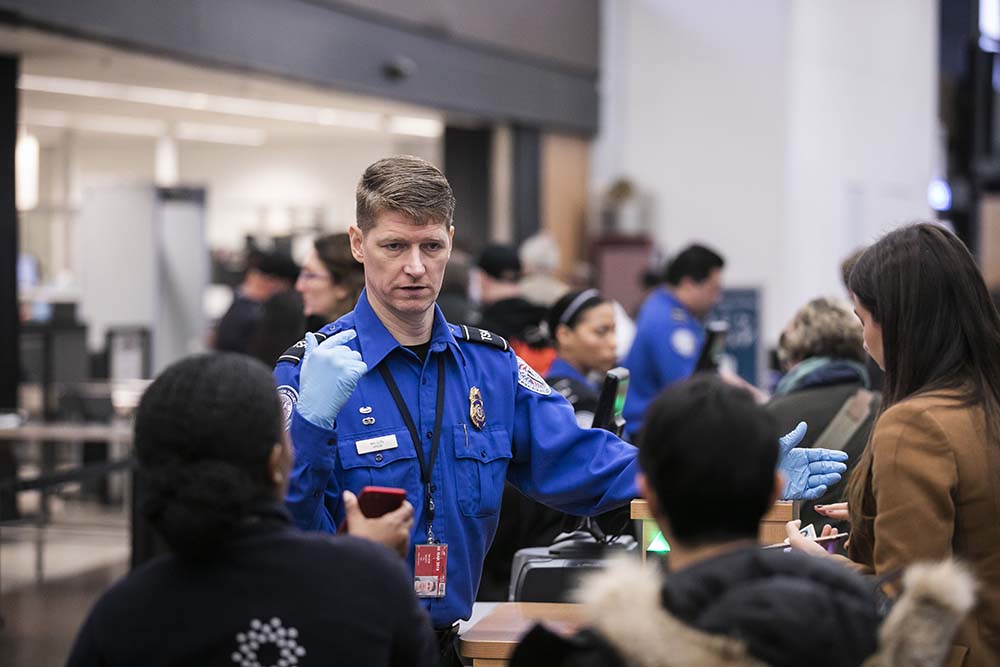
By law your driver’s license must be REAL ID-compliant if you want to use it to fly within the U.S. If your license is not compliant, you don’t have another acceptable form of ID, such as a U.S. passport, and you have not completed the ConfirmID process ahead of time, you may be subject to additional delays which may result in a missed flight. 

REAL ID-compliant driver’s licenses and the processes to get them are different state to statewhich can be confusing. In most cases, you’ll need to bring additional documentation to get a REAL ID-compliant driver’s license, and you might even need to make an appointment. See below for links to each state’s licensing agency or motor vehicle department.  

Many states identify their REAL ID-compliant driver’s licenses with a gold star in the upper right corner. But some states, such as Washington, use Enhanced Driver’s Licenses, which do not use gold stars for REAL ID-compliant licenses. However, EDLs are considered acceptable alternatives to REAL ID-compliant cards and will also be accepted for official REAL ID purposes. 

You have a choice.There are other forms of acceptable identification – for example, if you have a U.S. passport or a U.S. military ID – you can use that instead. Just remember to bring that ID to the airport. 

Frequently Asked Questions

Refresh my memory. What exactly is the REAL ID Act?

Congress passed the REAL ID Act in 2005 in an effort to strengthen identification rules at airports. The act established minimum security standards for state-issued driver licenses and identification cards.

What happens if I show up at the airport with my standard driver’s license as my only ID?

Until February 1, you will be delayed or possibly denied entry through TSA checkpoints. Starting February 1, travelers who appear at the TSA checkpoint without a REAL ID or other acceptable form of ID and have not already paid the TSA ConfirmID fee will be subject to additional delays which may result in a missed flight. If you have completed the TSA ConfirmID process, you must present either a printed copy or electronic copy of your fee payment when you enter the checkpoint. 

Will Alaska rebook me if I miss my flight because I don’t have a form of ID that is REAL ID compliant?

For our Main Cabin and First Class fares, no change fees will apply, but a difference in fare may be charged for your new flights. Per our no-show policy, you must change or cancel your reservation before your flight departs to receive future travel credit.

Saver fares cannot be changed day-of. Saver fares are eligible for a 50% credit when canceled at least 14 days prior to departure of the first flight on the ticket, or they may be eligible for cancellation under our 24-hour cancellation policy.

You can find more information about our change and cancellation policies here.

I know that I won’t have a compliant form of ID in time for my travel. Can I verify my identity ahead of time?

Yes! You can expedite your airport experience by using the tool at home, then presenting either a printed copy or an electronic copy of your fee payment receipt when you enter the checkpoint.

How long is ConfirmID good for?

ConfirmID verification is valid for 10 days. Any travel beyond the expiration date will require a new payment.

What forms of payment can I use to pay for ConfirmID?

You can pay the $45 fee via: 

  • Bank Account (ACH) 
  • PayPal account 
  • Venmo account 
  • Debit or credit card 
What information will I be required to disclose to TSA during the ConfirmID process?

The ConfirmID tool will require your first name, last name, effective/travel start date, and expiration date.  

I have questions about TSA ConfirmID. Who should I direct them to?

For questions about ConfirmID, contact TSA at https://www.tsa.gov/contact 

Am I required to get a REAL ID-compliant driver’s license?

No, it’s up to you to decide what’s best for your travel needs. You can use a current U.S. passport or a U.S. military ID at the airport to get through TSA security. Just remember to bring it. Having a REAL ID-compliant driver’s license is convenient for many of us because it’s something we always carry with us. Other acceptable forms of identification can be found here. 

If I update my license or get a new one, will it automatically be REAL ID compliant?

It depends on the state where you live. Some states now automatically issue a REAL ID compliant driver’s license when you renew, others, such as Washington, Oregon, Alaska, Hawaii, and California, do not. Some states will issue the compliant license for free; others will charge an additional fee. Please find your state in the list below to find more information about how to obtain a REAL ID-compliant driver’s license where you live. 

Alaska Air Group announces webcast of fourth-quarter 2025 financial results

AAG banner

Summary

Join us on January 23, 2026 at 8:30 a.m. PT/11:30 a.m. ET for Alaska Air Group’s Q4 2025 analyst conference call.

Alaska Air Group Inc., the parent company of Alaska Airlines Inc., Hawaiian Airlines, Inc. and Horizon Air Industries Inc., will hold its quarterly conference call to discuss 2025 fourth quarter financial results at 11:30 a.m. EDT/ 8:30 a.m. PDT, Friday, January 23, 2026. A webcast of the call will be available to the public at www.alaskaair.com/investors. An archive of the call will be posted on the website later that morning.

The company will file its fourth-quarter results and outlook after market close on Thursday, January 22, 2026.

About Alaska Air Group

Alaska Airlines, Hawaiian Airlines and Horizon Air are subsidiaries of Alaska Air Group, and McGee Air Services is a subsidiary of Alaska Airlines. We are a global airline with hubs in Seattle, Honolulu, Portland, Anchorage, Los Angeles, San Diego and San Francisco. We deliver remarkable care as we fly our guests to more than 140 destinations throughout North America, Latin America, Asia and the Pacific. We’ll serve Europe beginning in spring 2026. Guests can book travel at alaskaair.com and hawaiianairlines.com. Alaska is a member of the oneworld alliance, with Hawaiian scheduled to join oneworld in spring 2026. With oneworld and our additional global partners, guests can earn and redeem points for travel to over 1,000 worldwide destinations with Atmos Rewards. Learn more about what’s happening at Alaska and Hawaiian at news.alaskaair.com. Alaska Air Group is traded on the New York Stock Exchange (NYSE) as “ALK.”

Washington leaders launch Cascadia Sustainable Aviation Accelerator; position Pacific Northwest as global hub for sustainable aviation fuel

Alaska Airlines planes

Washington State leaders, aviation industry partners, research institutions, Tribal representatives and sustainability advocates today launched the Cascadia Sustainable Aviation Accelerator (CSAA).  Announced at the Boeing Future of Flight, the initiative is the most comprehensive and well-funded across the region of its kind to accelerate the production, deployment and adoption of sustainable aviation fuel (SAF).

Funded through a 2025 State of Washington appropriation and private philanthropic donation of an additional $10 million, the CSAA positions the Pacific Northwest as a global leader in an accelerated transition to sustainable aviation fuel while capitalizing on the once-in-a-generation economic opportunity of scaling local SAF production. In partnership with the Washington State Department of Commerce, CSAA is a non-profit organization dedicated to advancing the renewable fuels industry in the Pacific Northwest.

AS + Cascadia Header Image

Unlike traditional jet fuel, SAF is formulated from sustainable feedstocks, like crop seed oil, agricultural and forestry waste. Advancements in SAF technology and greater availability of affordable SAF will reduce the carbon footprint of air transportation, improve air quality and contribute to a more sustainable future while creating new industries, jobs and economic opportunities.

Sustainable aviation fuel puts the Cascadia region at the forefront of the next major chapter of the clean energy transition that will shape how the world is powered. This is the opportunity to do for clean fuels what this region did for the technology economy, creating lasting economic growth and leading the global effort to cut aviation emissions.”

Gov. Bob Ferguson

State of Washington

The Cascadia region has been a trailblazer in aerospace innovation for over a century, and today it is uniquely positioned as a global center of aviation innovation, with an opportunity to unlock the next generation of sustainable fuel. With access to local, low carbon feedstocks, affordable clean energy, established infrastructure and a skilled workforce, the region has all the elements necessary to support production of up to one billion gallons of sustainable aviation fuel by 2035. Scaling production at this level would drive economic prosperity and development, strengthen regional energy security and independence, support state and regional climate initiatives and build on Cascadia’s long legacy as an aviation innovator.

The global aviation industry, which generates some $4.1 trillion in economic activity and supports 86.5 million jobs, currently accounts for approximately 2-3% of global carbon dioxide emissions, in addition to other environmental impacts. SAF is a safe, effective drop-in solution projected to be used for the next 70-plus years that can reduce emissions by 80% compared to fossil-based fuels and the transition to a thriving circular economy through locally produced SAF.

Alaska aircraft
Fuel gauge

This initiative will be successful because it is grounded here, in the communities where aviation, manufacturing and clean energy intersect. CSAA builds on the infrastructure, workforce and partnerships we have already put in place, and this is just the beginning. Coalition partners like Washington State University are eager to partner in the establishment of a world class research and development facility adjacent to Paine Field. Combined with our region’s aviation industry cluster, these developments ensure we will be a leader in global aviation sustainability and investment well into the future.”

Dave Somers

Snohomish County executive, Chair of the CSAA board of directors

The region’s strength is built on advanced science, technology and aviation expertise, supported by leaders like Washington State University, Pacific Northwest National Laboratory and Boeing. This research foundation provides the technical backbone needed to move sustainable aviation fuel from small-scale production to commercial scale.

For the last six decades in Snohomish County, Boeing has relied on strong community partnerships to turn ambitious ideas into reality. Cascadia is a concrete example of that collaboration toward meaningful progress on a Sustainable Aviation Fuel ecosystem right here at home.”

Bill McSherry

Vice president of government operations, Boeing

Local aviation and technology leaders recognize that scaling SAF research and production will require coordinated action across the entire aviation ecosystem. Manufacturers like Boeing bring the technical expertise to integrate sustainable aviation fuels into aircraft and operations, while operators including Alaska Airlines and Amazon provide the operational expertise and market demand for cost-competitive SAF. Lawmakers, like Washington State Senator Marko Liias, have championed these partnerships at the state level by advancing legislation that supports SAF development and unlocks long-term investment.

Alaska Airlines and Hawaiian Airlines are committed to this journey to reduce carbon emissions for a more sustainable future for aviation, and while we are proud to be the most fuel-efficient premium U.S. carrier, SAF remains the biggest lever for us to meaningfully lower our emissions and reach our decarbonization goal. We’re thrilled to be a founding partner of CSAA because regional, cross-sector efforts like this are critical to align policy, public and private investment, to identify and invest in the right technologies and to incent and scale local production.”

Diana Birkett Rakow

CEO, Hawaiian Airlines

Combined with existing infrastructure, affordable clean energy and access to feedstocks, research institutions are advancing the science that makes sustainable aviation fuels viable, and policymakers are ensuring sustainability and airport community impacts remain central as the industry transitions to cleaner fuels.

Washington has led the world in aerospace innovation for generations, and now we face a defining moment for the next generation of aviation. Sustainable aviation fuel is essential to decarbonizing air transportation, and Cascadia is the one region with the research, industry, policy and workforce needed to scale it. This is the moment to act, and CSAA gives us the vehicle to lead.”

Sen. Marko Liias

State of Washington

The Jan. 8 launch event featured remarks from leaders across the aviation, research and public sectors. Executives from Alaska Airlines and Hawaiian Airlines and Boeing spoke to the importance of aligning the full ecosystem of manufacturers and operators, policy, research, financing and public awareness to scale sustainable aviation fuel and secure the long-term future of aviation. Representative Mia Gregerson highlighted the need to center sustainability and airport communities as the industry transitions to cleaner fuels. Washington State University President Elizabeth Cantwell underscored the role of research and innovation in advancing sustainable aviation fuel from the lab to commercial deployment, while Washington State Department of Commerce Director Joe Nguyễn addressed the state’s investments in clean energy, economic development and partnerships with Tribal nations.

The event also hosted a panel discussion moderated by Tim Zenk, a sustainable aviation fuel expert at Earth Finance, featuring executives Guy Palumbo at Amazon; Andy Billig, board member at SkyNRG; labor leader Jon Holden, Machinists Union, District 751; and Port of Seattle Executive Director Steve Metruck. The panel focused on investment pathways, workforce development and the economic opportunity presented by large scale sustainable aviation fuel production.

About Cascadia Sustainable Aviation Accelerator (CSAA)

Cascadia Sustainable Aviation Accelerator (CSAA) is a diverse, cross-sector coalition of public/private industry leaders committed to laying the foundation for sustainable aviation in Cascadia. CSAA recognizes the enormous economic and environmental value of the SAF transition and is dedicated to securing the Pacific Northwest as the next global hub for sustainable aviation.

About Alaska Air Group

Alaska Airlines, Hawaiian Airlines and Horizon Air are subsidiaries of Alaska Air Group, and McGee Air Services is a subsidiary of Alaska Airlines. We are a global airline with hubs in Seattle, Honolulu, Portland, Anchorage, Los Angeles, San Diego and San Francisco. We deliver remarkable care as we fly our guests to more than 140 destinations throughout North America, Latin America, Asia and the Pacific. We’ll serve Europe beginning in spring 2026. Guests can book travel at alaskaair.com and hawaiianairlines.com. Alaska is a member of the oneworld alliance, with Hawaiian scheduled to join oneworld in spring 2026. With oneworld and our additional global partners, guests can earn and redeem points for travel to over 1,000 worldwide destinations with Atmos Rewards. Learn more about what’s happening at Alaska and Hawaiian at news.alaskaair.com. Alaska Air Group is traded on the New York Stock Exchange (NYSE) as “ALK.”

Alaska Airlines announces largest fleet order in airline’s history

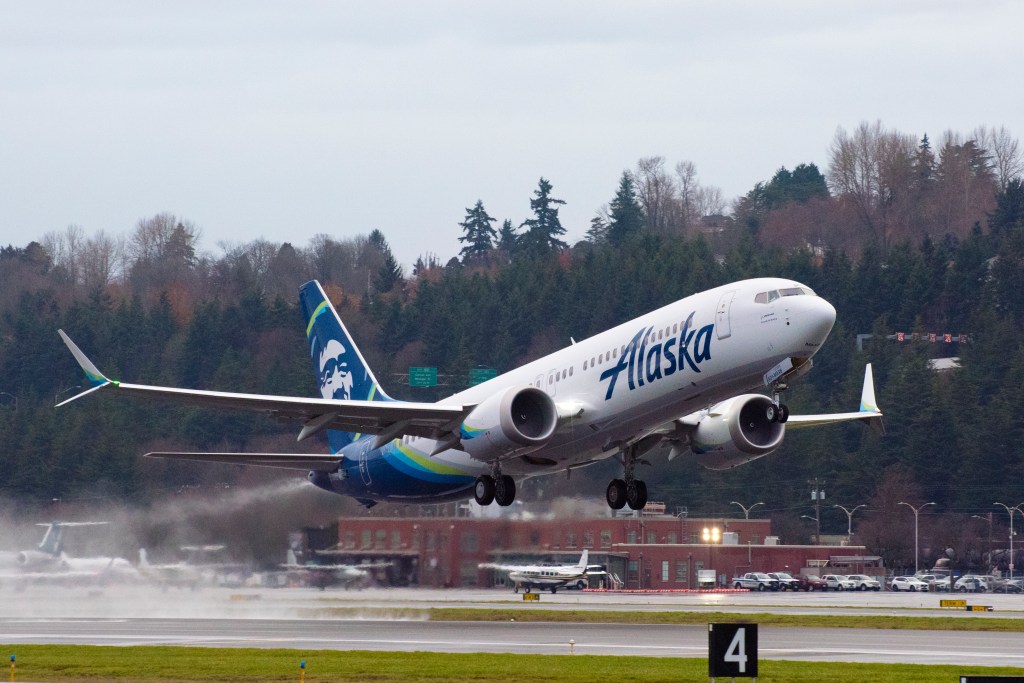
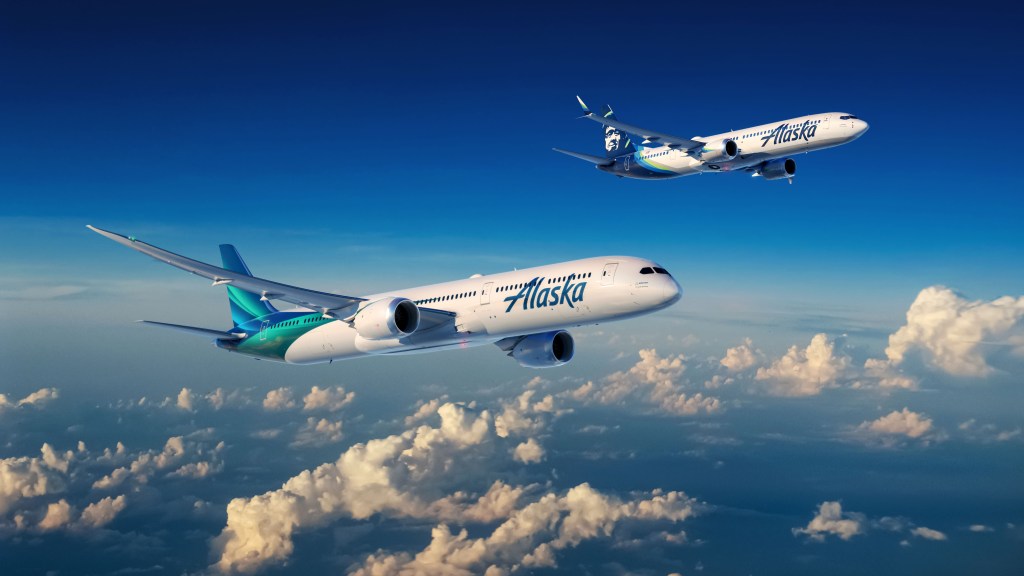
Alaska Airlines liveries

Summary

Alaska orders 105 737-10 aircraft and 5 787 widebody aircraft – extending the delivery stream through 2035.

The order includes an option for 35 additional 737-10 aircraft within the same timeframe.

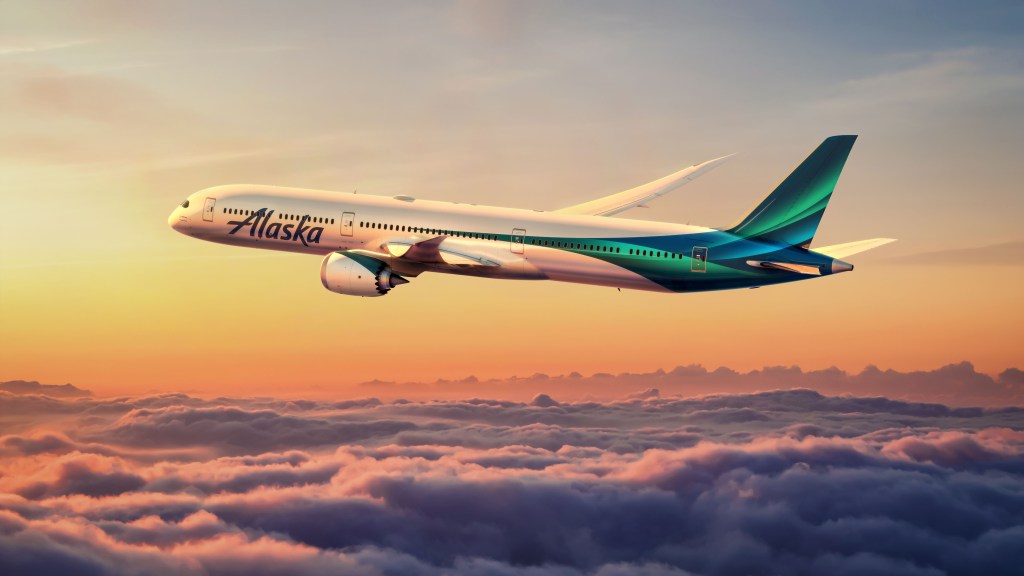
The airline will also welcome its first 787 widebody aircraft in the new Alaska global livery into its fleet, which will be seen operating across Europe and Asia.

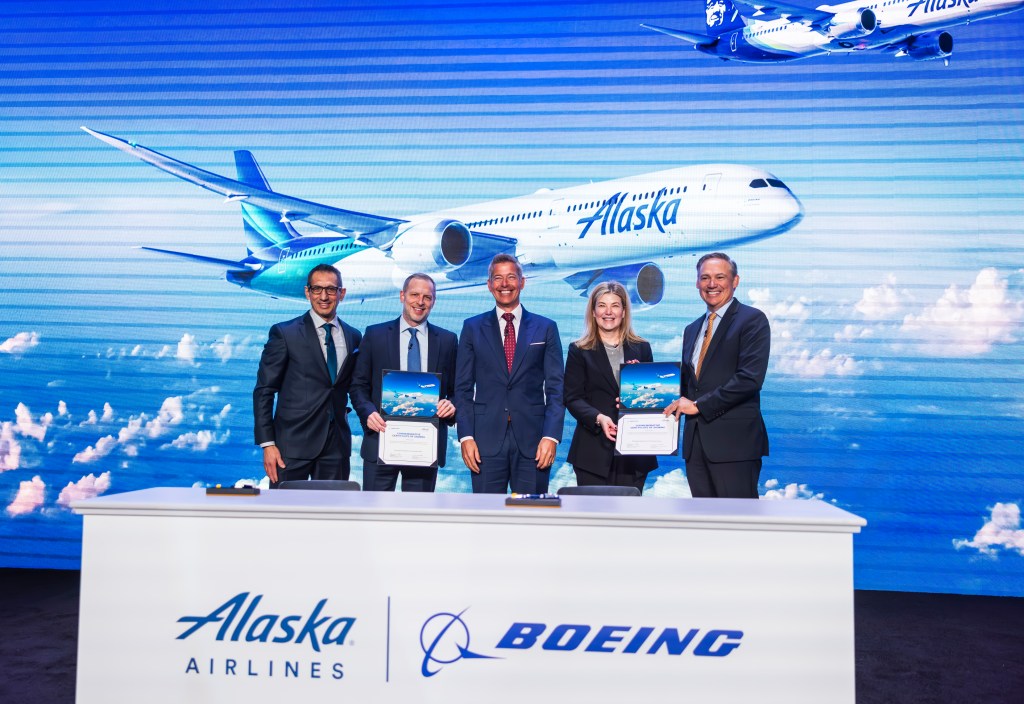
Alaska Airlines announced today it is ordering 105 new 737-10 aircraft and five new 787 aircraft – exercising all previous 787 options held with Boeing. The airline also secured rights for an additional 35 737-10 aircraft. This order – representing the largest order in the airline’s history – secures critical delivery slots and extends the aircraft delivery stream through 2035.

This fleet investment builds on the strong foundation Alaska has created to support steady, scalable and sustained growth, and is another building block in executing our Alaska Accelerate strategic plan. These planes will fuel our expansion to more destinations across the globe and ensure our guests travel aboard the newest, most fuel-efficient and state-of-the-art aircraft. We are incredibly proud to be partnering with Boeing, a Pacific Northwest neighbor and a company that stands as a symbol of American innovation and manufacturing.”


Ben Minicucci

CEO, Alaska Air Group

  • This order brings Alaska’s total 737 orderbook with Boeing to 245 aircraft, in addition to the 94 MAX aircraft we’re operating today.
  • A mix of growth aircraft and replacement for aging 737s, this order will keep Alaska’s fleet one of the youngest in the industry and the most fuel efficient for any premium, global airline.
  • Alaska already operates a narrowbody fleet that includes 737-9 and 737-8 aircraft. This order is for 737-10 aircraft, but the airline retains the flexibility to adjust to a different model if necessary.
  • The five additional 787 widebody aircraft support the Alaska Accelerate strategic plan and will enable the airline to fly to at least 12 long-haul international destinations from Seattle by 2030. The order brings our firm future 787 widebody fleet to 17, with five already in operation across the network. The intention is for these five 787s to be delivered as the -10 variant.
  • With a current fleet of 413 aircraft, Alaska Air Group’s carriers will operate a fleet of more than 475 aircraft by 2030 and more than 550 aircraft by 2035.
Route map

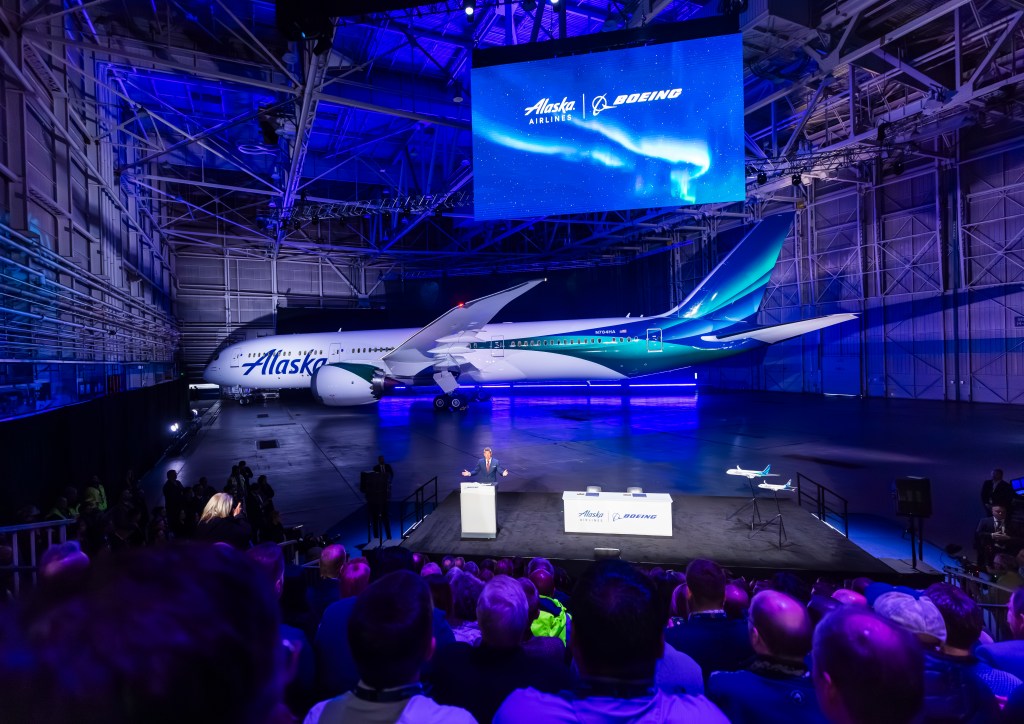
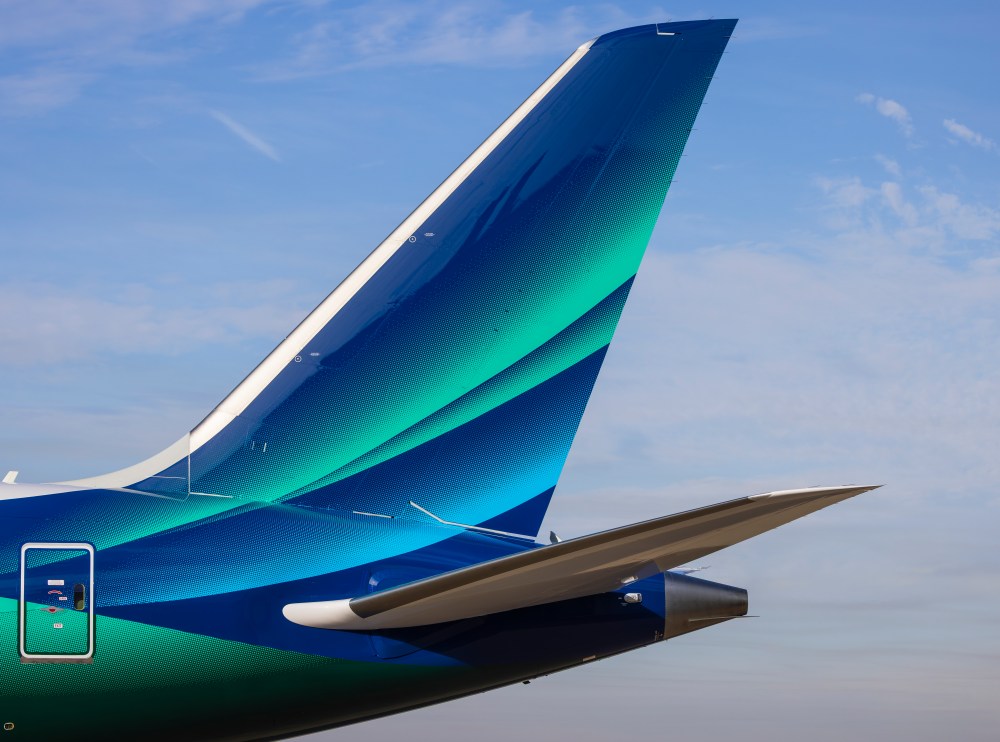
This morning in Seattle, leaders from Alaska Airlines, Boeing and the U.S. Department of Transportation will join with employees, customers and guests to celebrate this fleet order and welcome the first 787-9 painted in Alaska’s global livery. The new 787-9 exterior design draws inspiration from the natural wonder of the Aurora Borealis, featuring a palette of deep midnight blues and lush emerald greens that channel the aurora’s energy and spirit of the Alaska brand. Utilizing a new aircraft painting technique, it took artists nearly 1000 hours across 13 days to paint the aircraft exterior from nose to tail.

Executives in front of the 787 aircraft
Executives standing with employees
Secretary Sean Duffy speaking at reveal event
Boeing 787 with the global livery
Ben Minicucci speaking at reveal event
Employee photographing the Boeing 787

As we transform into the country’s fourth largest global airline, we are proud to introduce a new, global livery for the Alaska brand. The design is a tribute to Alaska’s rich history and a reflection of our bold vision for international growth and our commitment to connect the Pacific Northwest to the world.”

Ben Minicucci

CEO, Alaska Air Group

woman pouring blue paint into bucket
Alaska Airlines plane being painted
Alaska Airlines global livery being painted
Alaska Airlines Global Livery Tail
Alaska Airlines Global Livery Fuselage and Engine
Alaska Airlines global livery in front hangar

As the company’s brand strategy expands to meet its growing global footprint, essential elements of our two airline brands’ legacies and history remain unchanged. The core Alaska Airlines brand expression will remain with the Alaska Native on the tail of narrowbody aircraft flying throughout the North American continent. The Hawaiian Airlines brand will continue to be expressed in service to, from and within the Hawaiian Islands with Pualani on the tail of Airbus A321, A330 and Boeing 717 aircraft.

Flights to Europe and Asia from our expanding global gateway in Seattle are available for booking now at alaskaair.com:

  • London Heathrow, United Kingdom: Daily, year-round flights beginning May 21, 2026
  • Rome, Italy: Daily, summer seasonal flights beginning April 28, 2026
  • Reykjavik, Iceland: Daily, summer seasonal flights beginning May 28, 2026 (operated on a 737-8 MAX)
  • Tokyo Narita, Japan: Daily, year-round flights already in service
  • Seoul Incheon, South Korea: five-times-weekly, year-round flights already in service

About Alaska Air Group

Alaska Airlines, Hawaiian Airlines and Horizon Air are subsidiaries of Alaska Air Group, and McGee Air Services is a subsidiary of Alaska Airlines. We are a global airline with hubs in Seattle, Honolulu, Portland, Anchorage, Los Angeles, San Diego and San Francisco. We deliver remarkable care as we fly our guests to more than 140 destinations throughout North America, Latin America, Asia and the Pacific. We’ll serve Europe beginning in spring 2026. Guests can book travel at alaskaair.com and hawaiianairlines.com. Alaska is a member of the oneworld alliance, with Hawaiian scheduled to join oneworld in spring 2026. With oneworld and our additional global partners, guests can earn and redeem points for travel to over 1,000 worldwide destinations with Atmos Rewards. Learn more about what’s happening at Alaska and Hawaiian at news.alaskaair.com. Alaska Air Group is traded on the New York Stock Exchange (NYSE) as “ALK.”

Hawaiian Airlines, a part of Alaska Airlines, announces Kahu‘ewai Hawai‘i Investment Plan of more than $600M over five years to modernize infrastructure and guest experience, and deepen its commitment to the community and sustainability

Hawaiian Airlines A330 Reef Runway header

Summary

Major airport renovations include improved lobbies, gates and amenities at Honolulu, Līhu‘e, Kahului, Kona and Hilo, plus a new premium lounge in Honolulu.

The airline will update its app and website, offering better travel planning and self-service features, and invest in new technology for employees.

The carrier is investing in a refreshed onboard experience with upgraded widebody Airbus A330 interiors, while offering enhanced rewards and exclusive benefits to loyal Hawai‘i residents.

Hawaiian Airlines, a part of Alaska Airlines, today unveiled an investment plan of more than $600 million over five years to comprehensively enhance the experience for guests traveling to, from and within the islands by modernizing airport spaces, upgrading technology and retrofitting aircraft interiors, while expanding community and sustainability work across Hawai‘i.

Hawaiian Airlines’ Kahuʻewai Hawai‘i Investment Plan will improve the guest experience from booking to the day of travel and provide airport and in-flight teams with modern tools and spaces to welcome travelers with their award-winning Hawaiian hospitality. Investments will also help Hawaiian advance lower emission technologies and programs promoting regenerative tourism, culture and conservation.

Hawaiian Airlines is proud to call Hawai‘i home, to reflect the spirit of the islands, to take care of our local guests and welcome visitors, and support our communities. Our Kahu‘ewai Hawai‘i Investment Plan represents one of Hawaiian Airlines’ largest single investments in our infrastructure, products and services in Hawai‘i. It reflects our kuleana to our people and guests in the islands and reinforces our commitment to deliver safe and remarkable service that enables Hawai‘i and Hawaiian Airlines to thrive.”

Diana Birkett Rakow

Chief executive officer, Hawaiian Airlines

Kahuʻewai signifies fresh water bursting forth as a metaphor for vital resources. Much like water that flows and nurtures, the investments will deliver benefits across Hawaiian Airlines and communities in Hawai‘i today and for a long time to come.
They include:

Airports

Starting this year through 2029, Hawaiian Airlines will renovate lobbies and gates in Honolulu, Līhu‘e, Kahului, Kona and Hilo to improve passenger flow and comfort, with bright, elegant open spaces and better seating and amenities like increased power charging. In Honolulu, Hawaiian’s busiest hub, the airline will build a spacious 10,600-square-foot premium lounge at the entrance of the Mauka Concourse in Terminal 1 – setting a new standard of preflight comfort.

Hawaiian Airlines Lobby Rendering
Hawaiian Airlines waiting area rendering
Hawaiian Airlines HNL Lounge

Technology

This spring, Hawaiian Airlines will launch an updated, modern app and website with improved functionality to simplify travel planning, booking and trip management with self-service features like changing flights and redeeming award travel on global partners. The airline is also investing in new technology to support employees in their critical roles across the operation. Full functionality of these tools – and a significantly smoother guest experience – will be possible once Hawaiian Airlines and Alaska Airlines share the same passenger service system and Hawaiian Airlines joins the oneworld alliance, both scheduled for late April.

Aircraft

Hawaiian Airlines’ fleet of widebody Airbus A330s, based in Honolulu, will undergo a full interior upgrade, starting in 2028, with new seats, carpets, lighting, first class suites, and a premium economy cabin. Guests will also enjoy a Bluetooth-enabled in-flight entertainment system with high-definition seatback screens and an extensive movie and music library, along with fast and free Starlink Wi-Fi. The airline is also acquiring three of its A330 aircraft off lease to support the future of this fleet in its service across the Pacific.

Hawaiian Airlines A330 Aircraft

Loyalty

Later this year, Hawaiian Airlines will reward Hawai‘i residents who are members of its popular Huaka‘i by Hawaiian loyalty program with a 50% bonus on Atmos Rewards points and status points earned on Neighbor Island flights, adding to exclusive kama‘āina benefits that include a free checked bag, 10% or 20% quarterly discounts when flying within the state, and monthly systemwide deals.

Surfer image

Community impact

Hawaiian Airlines remains deeply engaged in the community, with expanded partnerships in education and workforce development initiatives, new grant-making opportunities, promoting regenerative tourism efforts through its Travel Pono program and new investments to preserve Hawai‘i’s natural resources and to advance new technologies for a more sustainable future.   

Team Kokua volunteers

Hawaiian Airlines’ investment is exactly the kind of long-term commitment Hawaiʻi needs. Modern, welcoming airports improve the experience for residents and visitors alike, strengthen our economy and keep Hawaiʻi competitive as a global destination. We appreciate Hawaiian Airlines’ partnership in advancing workforce development, regenerative tourism, clean energy and community programs that reflect the values of our islands.” 

Gov. Josh Green

State of Hawaiʻi

As part of its community and sustainability initiatives, Hawaiian is expanding a partnership with business accelerator Mana Up through an investment in its Mana Up Capital II fund to help more local companies scale for the global market. Hawaiian has featured more than a dozen local retailers in the food, fashion, beauty and home and art sectors in its onboard service since becoming Mana Up’s official airline sponsor in 2017.  

Hawaiian last month announced it is investing in locally produced sustainable aviation fuel (SAF) to reduce flight emissions and support agriculture in partnership with Pono Pacific and Par Hawaii, and that it would be the first airline to take deliveries of Hawai‘i-made SAF later this year. The airline is also working to advance innovative lower-emission options for short-haul air service with an investment in hybrid-electric propulsion developer Ampaire and increasing use of electric ground service vehicles at Honolulu airport. 

Finally, the airline will be providing grants to nonprofit organizations promoting cultural programs, environmental preservation and perpetuation of native Hawaiian art and language through the Alaska Airlines | Hawaiian Airlines Foundation, a newly integrated 501(c)(3) foundation dedicated to these efforts in their two namesake states. 

The Hawaiian Airlines’ Kahuʻewai Hawai‘i Investment Plan is part of Alaska Air Group’s Alaska Accelerate strategic plan to deliver on the combined airline’s vision of connecting guests to the world with a remarkable travel experience rooted in safety, care and performance. 

About Alaska Air Group

Alaska Airlines, Hawaiian Airlines and Horizon Air are subsidiaries of Alaska Air Group, and McGee Air Services is a subsidiary of Alaska Airlines. We are a global airline with hubs in Seattle, Honolulu, Portland, Anchorage, Los Angeles, San Diego and San Francisco. We deliver remarkable care as we fly our guests to more than 140 destinations throughout North America, Latin America, Asia and the Pacific. We’ll serve Europe beginning in spring 2026. Guests can book travel at alaskaair.com and hawaiianairlines.com. Alaska is a member of the oneworld alliance, with Hawaiian scheduled to join oneworld in spring 2026. With oneworld and our additional global partners, guests can earn and redeem points for travel to over 1,000 worldwide destinations with Atmos Rewards. Learn more about what’s happening at Alaska and Hawaiian at news.alaskaair.com. Alaska Air Group is traded on the New York Stock Exchange (NYSE) as “ALK.”

2025 wrapped: a look back on Alaska Airlines and Hawaiian Airlines’ first combined year  

A year of meaningful progress on the integration between Alaska Airlines and Hawaiian Airlines, 2025 was full growth, innovation and impact across our newly combined company. Let’s take a moment to look back at some of the biggest highlights of the year. 

Hawaiian Airlines guest service agent

Expanding our global reach and network 

We proudly carried more than 55,000,000 passengers on more than 486,000 flights across our combined global network.  

We announced five new global destinations from our Seattle hub — Seoul, Tokyo, Reykjavik, Rome and London — opening doors to new adventures and cultural connections. 

Over Thanksgiving, our employees delivered the best operation in the industry, achieving the highest on-time performance of any U.S.-based carrier. 

We expanded our schedule and connectivity by adding 21 new domestic routes in 2025, including nonstop service between San Francisco and both Kona and Lihue in Hawai’i, Portland to Houston, Anchorage to Sacramento and the first-ever nonstop service between San Diego and Washington National (DCA).  

We carried more than 40,000 tons of cargo to and from remote communities across Alaska, Hawaiʻi and the Pacific region — the equivalent of over 400 fully loaded Boeing 737‑9 passenger aircraft — ensuring vital goods reached those who need them most.   

Tokyo
Rome
London
Atmos Rewards Rome image

Loyalty and travel perks, reimagined

We introduced Atmos Rewards, our new combined loyalty program, bringing the best of our airlines into a single industry-leading rewards ecosystem. Atmos Rewards won major “Best Airline Rewards Program” awards from publications like U.S. News & World Report and NerdWallet in 2025, and was praised for distance-based earning, high value, companion awards and generous elite status perks. 

We launched the Atmos™ Rewards Summit Visa Infinite® card, co-branded with Bank of America, our most generous card with over 15 benefits, including an annual 25,000-point Global Companion Award, a 100,000-point Global Companion Award after qualifying purchases, eight Alaska Lounge passes annually and the fastest path to status with one status point for every $2 spent on purchases. At the same time, the Alaska Airlines Visa Signature® card was transformed into the Atmos Rewards Ascent Visa Signature® card.*   

Across our combined network, we proudly welcomed over 7,500 Million Milers and 890,000 Atmos status holders. Through the new Atmos Rewards program, status members enjoyed enhanced complimentary upgrades — with over 63,000 premium upgrades delivered in 2025. 

We celebrated one year of Huakaʻi by Hawaiian in the state of Hawaiʻi and 14 years of Club 49 in the state of Alaska. 

Alaska model aircraft being held by Santa
Hawaiian Airlines logo store items
Alaska company store items
Team Kokua image

Investing in the communities we serve 

During our annual Week of Care, held in October, nearly 500 volunteers across Alaska Airlines, Hawaiian Airlines, and Horizon Air supported 24 community partner projects across our network, including Alaska, California, Florida, Idaho, Hawaiʻi, Oregon, Washington, and Washington, D.C.   

Hawaiian Airlines awarded 500,000 Atmos Rewards points to each of its 14 Atmos Giving by Hawaiian partners in celebration of Giving Tuesday.  

We created a new 501(c)(3) foundation to support nonprofits with grants in each of our namesake states. The Alaska Airlines | Hawaiian Airlines Foundation will continue investing in programs that celebrate and preserve the unique way of life in Alaska and Hawai‘i.

Group shot of Hawaiian Airlines donation
Hokulea
Alaska care team
Starlink

Elevating the guest journey

Alaska Airlines installed complimentary Starlink earlier than planned on several of its Embraer E175, and Hawaiian Airlines guests embraced the service, streaming more than 177,095 hours over the year — the equivalent of streaming for 7,379 straight days or over 20 years. On average, about 200 devices were connected to the high-speed, low-latency service during each transpacific flight – even while traversing remote stretches of the Pacific  

We introduced exciting new collaborations with three award‑winning chefs — Seattle’s Brady Ishiwata Williams and San Francisco’s Brandon Jew on Alaska Airlines, and Hawaiʻi’s Jason Peel on Hawaiian Airlines — elevating our inflight culinary experience in our First Class cabins.   

Alaska also introduced new snacks and chef-driven meals for guests in its Main Cabin, including its newest 100% plant-based and gluten-free The Best Laid Plants grain bowl – available on select flights.  

Our guests also began collecting new pilot trading cards from both Alaska and Hawaiian – including exclusive digital collectible cards available only onboard Hawaiian Airlines aircraft. 

We introduced an industry-leading surfboard policy, making it easier for surfers to bring their boards along for the ride. And we combined check-in lobbies and airport operations at most of our hubs, creating a smoother, more consistent travel experience. 

Brandon Jew dishes
Jason Peel dish
Chef Brady dish
Disney Tiana livery

New liveries to mark the moment 

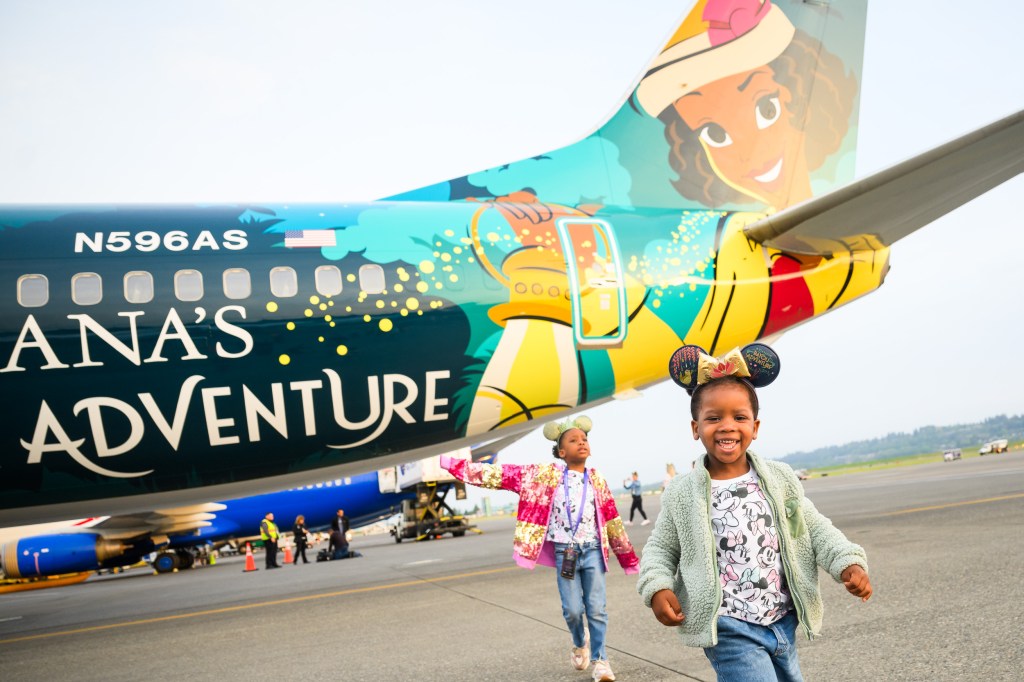
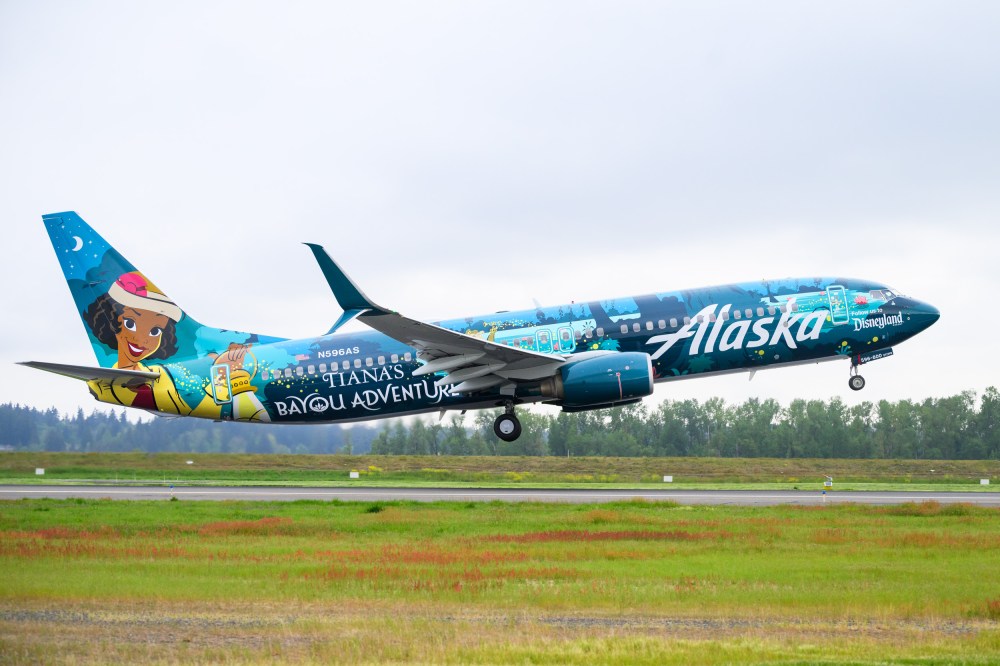
Alaska Airlines unveiled its newest Disneyland Resort-themed aircraft, Tiana’s Bayou Adventure Flyer, featuring a vibrant livery inspired by “The Princess and the Frog” and the Tiana’s Bayou Adventure attraction at Disneyland Park. 

Hawaiian Airlines celebrated the release of Disney’s live‑action Lilo & Stitch with three playful aircraft liveries, as well as a new Lilo & Stitch-themed travel pono (responsibly) in-flight video. 

We revealed a first glance at Alaska Airlines’ new global livery for the Boeing 787 Dreamliner. Inspired by the natural wonder of the aurora borealis, this aircraft will support our combined company’s long-haul, international expansion out of Seattle. 

HA_LiloStitch_A330_AirtoAir-ALOHA_mid
Tiana livery
Alaska Global Livery for the Boeing 787-9 Dreamliner
Honeycreeper bird

Building a pipeline of aviation talent 

We welcomed over 5,000 new employees across Hawaiian Airlines and Alaska Airlines, growing our team of passionate people dedicated to safety, hospitality and care.   

Hawaiian Airlines, Alaska Airlines and Horizon Air proudly served as title sponsors of the Organization of Black Aerospace Professionals (OBAP) Conference — a first for our combined company. 

Horizon Air expanded its Pilot Development Program to Hawaiʻi, the first of its kind in the state, offering aspiring pilots a pathway to join the carrier while easing training costs. 

Hawaiian Airlines and Honolulu Community College expanded their workforce development partnership with the launch of the Maintenance Technician Development Program (MTDP), an initiative to train the next generation of aviation maintenance technicians. 

Hawaiian Airlines and Alaska Airlines were recognized as 2025 Outstanding Businesses by local nonprofit ClimbHI for the third consecutive year, recognizing our efforts to engage Hawaiʻi-based students and teachers in aviation careers.

aviation tech
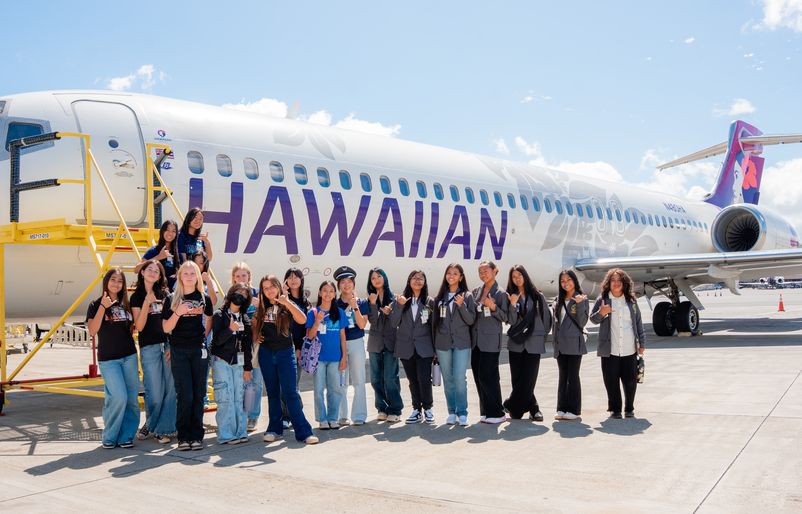
HA_Girls_in_STEM-44_mid
Alaska company store items

Innovating and investing in sustainability  

Alaska Airlines and Hawaiian Airlines, the most fuel-efficient U.S. premium carriers, saved over 7.3 million** gallons of fuel through fuel efficiency initiatives.

We became a lead investor and helped launch the oneworld Breakthrough Energy Ventures fund to accelerate innovation in the global development of SAF.  

We also invested in over nine million gallons of sustainable aviation fuel (SAF)  enough to fill 14 Olympic-sized swimming pools. 

We continued to expand our SAF use by entering into an offtake agreement with Japan’s Cosmo Oil Marketing for our Osaka–Honolulu flights. 

Alaska Airlines planes
Hawaiian Airlines logo store items
A330 on tarmac

Looking ahead

As we turn the page to 2026, we’re focused on executing our Alaska Accelerate strategic plan: launching new service to Europe, unlocking the full power of Atmos Rewards, and bringing our premium experience to even more guests.

With exciting destinations on the horizon, strong foundations built in our hubs and growing investment in our hometowns of Honolulu and Seattle, we’re embarking on our journey to make travel — no matter what country or small town you’re flying from — more seamless and rewarding than ever before.

*The Atmos Rewards credit card program is issued and administered by Bank of America, N.A.  Visa Signature and Visa Infinite are registered trademarks of Visa International Service Association and are used by the issuer pursuant to license from Visa U.S.A. Inc.

**Based on data reported through October 2025.

Hawaiian Airlines and Polynesian Voyaging Society honor a legacy of wayfinding in Auckland

PVS header

Hawaiʻi’s Polynesian Voyaging Society (PVS) has sailed with the spirit of exploration for over 50 years, reviving traditional wayfinding and inspiring cultural pride throughout the Pacific. That legacy was honored last month in Aotearoa (New Zealand), where Māori communities welcomed crews aboard the double-hulled canoes Hōkūleʻa and Hikianalia with a powerful and moving welcome. The arrival of PVS crews coincided with the return of our 2025–2026 seasonal service between Auckland and Honolulu.

Hawaiian's Airbus A330 at AKL Airport
A shared return to Auckland

On Nov. 17, our Airbus A330, named Hikianalia after the star Spica, touched down in Auckland as the first of two vessels to carry the name. Debbie Nakanelua‑Richards, Hawaiian Airlines’ director of community and cultural relations, was among those on board the flight that evening. The following morning, she joined Ngāti Whātua Ōrākei tribal members at Ōkahu Bay — their ancestral homeland — to welcome PVS sister canoes Hōkūleʻa and Hikianalia to port.

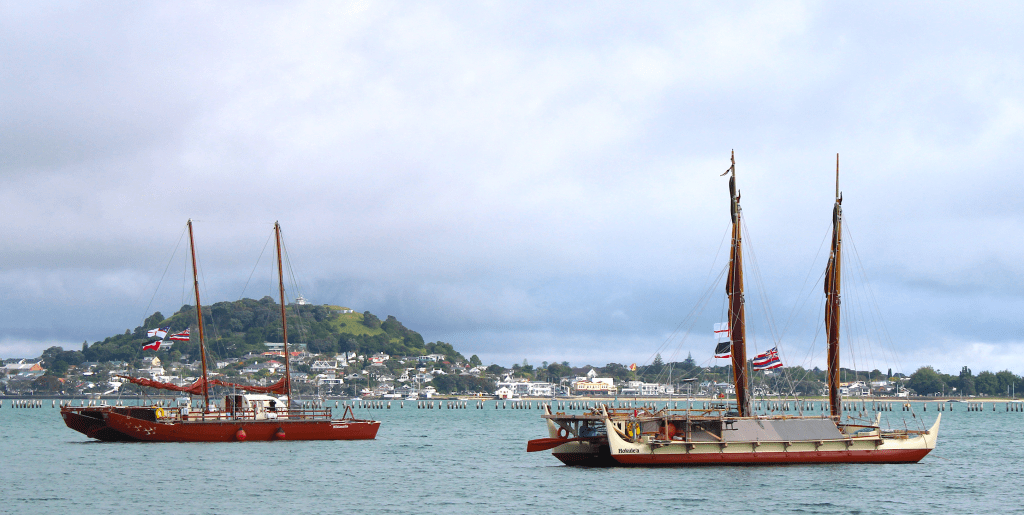
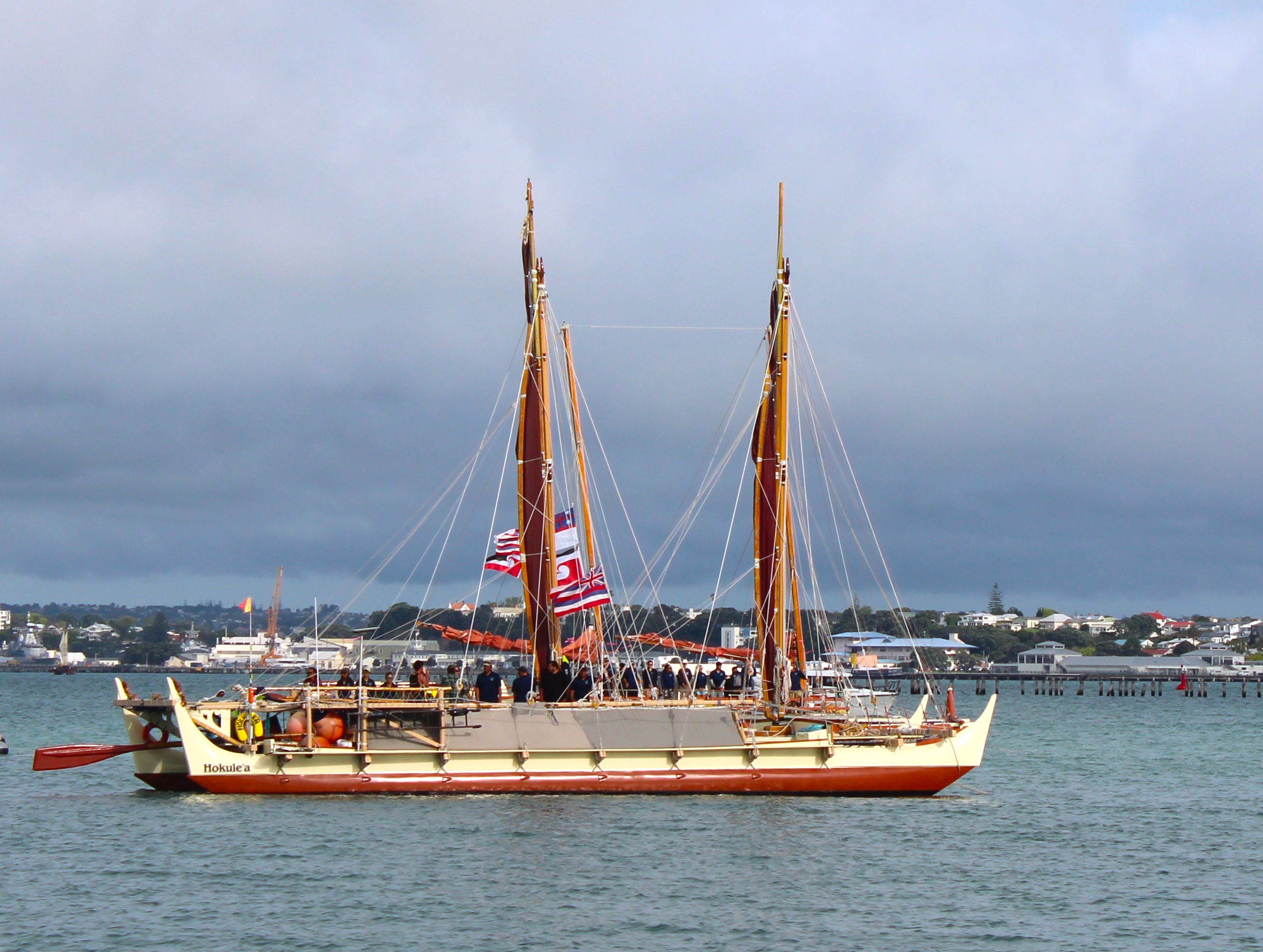
As Hōkūleʻa and Hikianalia emerged on the horizon of Auckland’s Ōkahu Bay, they were soon escorted by the waka hourua (Māori double‑hulled canoe) of the Te Toki Voyaging Trust — a nonprofit dedicated to preserving traditional wayfinding knowledge for Māori. The cultural welcome was a powerful gesture of collective respect for the canoes and their crews, who had sailed from Honolulu to Tahiti, Rarotonga and finally Aotearoa using the same ancient wayfinding techniques as their ancestors, without navigational instruments or modern technology.

The Aotearoa arrival marked another successful leg of PVSʻs Moananuiākea Voyage, a 43,000-nautical-mile, 47-month circumnavigation of the Pacific that touches 36 countries and archipelagoes, nearly 100 indigenous territories and 345 ports.

Hokulea
PVS crew response at welcome
PVS canoes in Auckland
A cultural renaissance

As a teenager in the 1970s, Debbie developed a keen interest in PVS. The nonprofit was founded in 1973 and spent years focusing on reconstructing traditional Hawaiian double-hulled voyaging canoes and recovering ancient wayfaring knowledge. Hōkūle‘a, the first and foundational canoe of PVS, made history in 1976 when it completed its first voyage to Tahiti. The canoe was welcomed by more than 17,000 Tahitians, over half of Pape‘ete’s population at the time, underscoring a shared commitment to safeguarding indigenous values and practices across Hawaiʻi and the Pacific.

“It was a time when Hawaiian culture was at risk of extinction, so there was deep concern to preserve and pass on important cultural knowledge – our language, dance, music, art, carving and the legacy of exploration and navigation. Hōkūleʻa ignited a cultural renaissance in Hawaiʻi, which continues today,” Debbie said.

Connected by ocean (and air)

Today, Hōkūleʻa continues to carry crews around the world as they convey messages about respecting oceans, protecting cultural knowledge and caring for native communities and the environment.

Hawaiian Airlines, Hawaiʻiʻs carrier for 96 years, has proudly supported PVS for nearly five decades. As the official airline sponsor of the Moananuiākea Voyage, weʻve contributed 34 million miles (now points) to help transport voyagers during crew swaps and critical cargo during food and supply restocks. Our expansive network has also long connected a handful of Pacific communities touched by the Voyage, including Auckland, a city we have proudly served since March 2013.

Maori woman on the shore looking out at canoe
Crew reflections at the arrival

Jay Tansley, the first Māori to become a U.S. Navy SEAL, described the voyage as profound. Born in Aotearoa, his family moved to Hawaiʻi when he was five. He joined PVS to add his skills to the Moananuiākea Voyage.

“Nainoa Thompson [master navigator and CEO of PVS] first told me, ‘the canoe will take you home,’ and ever since, the experience has been incredible,” he said. 

“We approached in darkness, but between lightning strikes, we recognized Aotearoa’s long white cloud stretched over Mount Manganui. It was then that we estimated we were only about 200 miles off the coast.”

Kalā Baybayan-Tanaka grew up around voyaging canoes, learning from her father, the late master navigator and Captain Kālepa Baybayan, who crewed Hōkūleʻa in 1975 and on all major voyages. She joined PVS nearly two decades ago and has voyaged on both Hikianalia and Hōkūleʻa as captain, watch captain, navigator, safety officer and education specialist.

“It’s my hope that Hōkūleʻa continues to sail the sea roads that connect our past and future and that our decks stay full with ʻohana of the waʻa [family of the canoe] as we teach and pass on knowledge to future generations,” she said.

Debbie and Kala
PVS crewmembers
PVS crew sharing a breath with a Maori man
Our commitment to Hawaiʻi and PVS

While welcoming the canoes, Debbie reiterated Hawaiian Airlines’ longstanding commitment to PVS and Hawaiʻiʻs rich culture.

“Deeply embracing culture and supporting organizations like the Polynesian Voyaging Society is and has always been a priority,” she said.

“When people see Hawaiian Airlines, they see Hawaiʻi and think of a people, a place and a culture. There is kuleana, or responsibility, that comes with that, and so it matters how we show up to celebrate Hawaiʻi and share our culture – not just at home, but also with the communities we serve.”


To learn more about the Moananuiākea Voyage and the Polynesian Voyaging Society, visit hokulea.com.


Watch Hawaii News Now’s reporting on the canoes’ Auckland arrival:

Now boarding: Alaska Airlines debuts new Premium Class Snack Basket

Snack basket

Summary

We’re introducing a complimentary Premium Class Snack Basket on select long-haul flights, featuring a curated selection of sweet and savory options, available now.

This new offering enhances the Premium Class experience and complements our industry-leading pre-order program for fresh, chef-crafted meals across cabins.

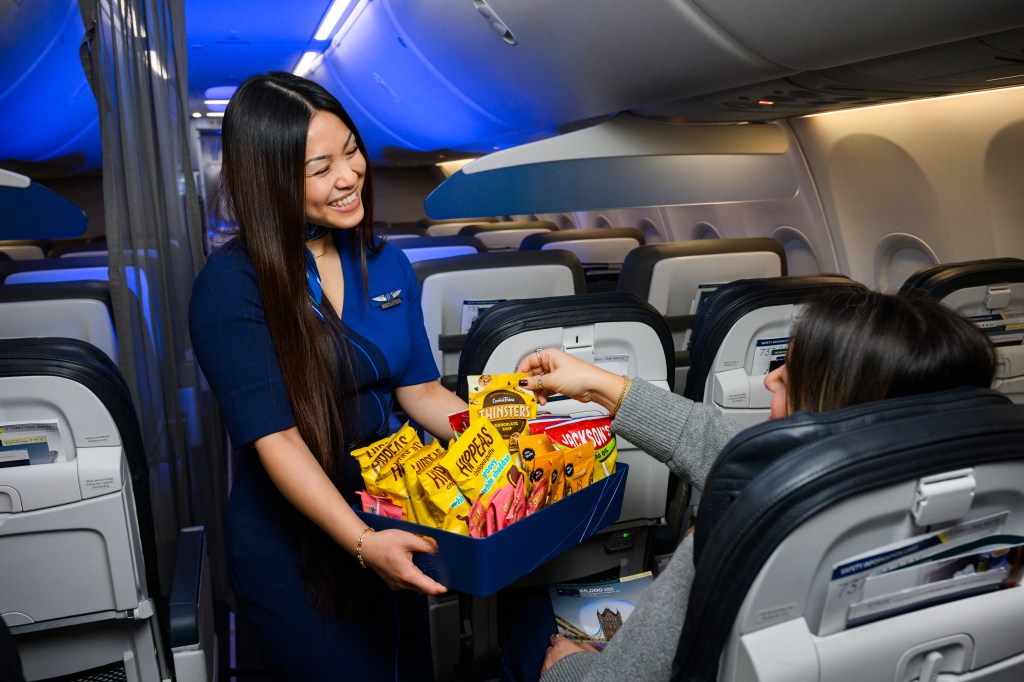
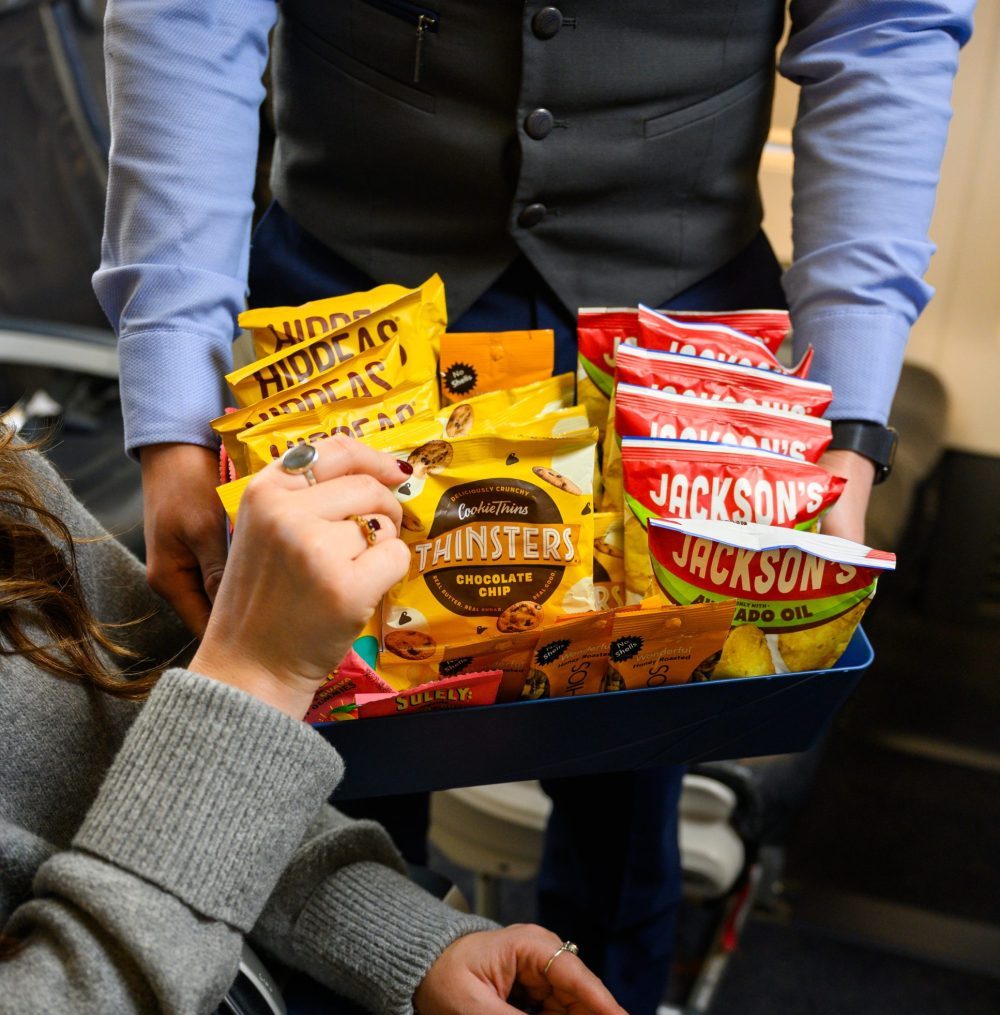
Alaska Airlines is giving guests something new to savor at cruising altitude with the debut of our Premium Class Snack Basket, now rolling out on select long-haul flights across our network.

The Premium Class Snack Basket, complimentary for Premium Class guests, is the latest example of our commitment to making every mile matter — pairing signature hospitality with elevated food and beverage offerings on most flights over 2,100 miles. Starting today, Premium Class guests can choose up to two complimentary snacks from our curated Premium Class Snack Basket, available on select flights.

ASHA

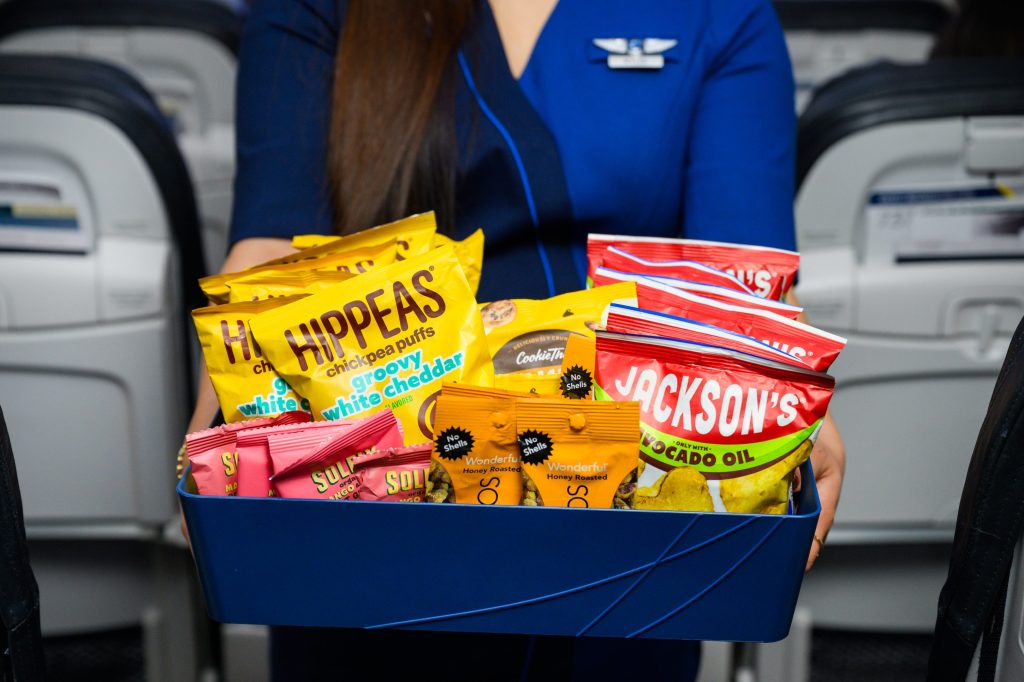
Hand-selected with care and curated from beloved West Coast brands, our new Premium Class Snack Basket offers an intentional mix of sweet and savory favorites. Guests can indulge in Thinsters Chocolate Chip Cookies and Jackson’s Avocado Oil Sea Salt Potato Chips or opt for a lighter snack such as Hippeas Groovy White Cheddar Puffs, Honey Roasted Wonderful Pistachios from Los Angeles, California and vegan-friendly Soley Organic Fruit Gummies from San Diego.

The Premium Class Snack Basket offers a rotating lineup of high-quality snacks that balances indulgent treats with feel-good favorites. Selections will evolve seasonally, keeping the experience fresh for both frequent flyers and first-time guests.

Our Premium Class experience is already among the best in the industry and starting today, we’re making it even better with a thoughtful, delicious touch. We designed our new snack basket with our guests in mind as another way to say thank you for choosing Alaska, and to help create a memorable experience before they even reach their destination.”

Todd Traynor-Corey

Vice President of guest experience & products, Alaska Airlines

Snack basket
Snack basket

Alaska’s industry-leading pre-order program offers more inflight dining options than any other U.S., delivering a premium dining experience no matter where our guests sit. Guests in First Class enjoy complimentary chef-curated meals, while those in Premium Class and Main Cabin can savor fresh, chef-crafted meals by pre-order through their Alaska Airlines app. Pre-orders are available up to 14 days in advance and until roughly 20 hours before takeoff, including at least one hot meal option on flights over 1,100* miles, and feature favorites like the Signature Fruit & Cheese Platter.

*Certain meal options may not be available on some flights, including redeye flights or where catering is not available

Alaska Air Group welcomes Ryan Sather as new vice president of safety and security

Alaska-AirGroup-Featured

Summary

Ryan Sather will become Vice President of Safety and Security for Alaska Air Group and Alaska Airlines.

Sather brings more than a decade of experience at Alaska and Horizon as well as a 26-year career in the United States Marine Corps.

The Alaska Air Group board of directors has elected Ryan Sather as vice president of safety and security for Alaska Air Group and Alaska Airlines, where he will lead safety and security functions across the company’s airline operations. The transition reinforces the company’s unwavering commitment to the safety of its employees and guests.

Safety is the foundational value at Alaska, Hawaiian, Horizon and McGee, and their individual safety programs are built on trust, innovation, and a shared dedication to protecting guests and employees. In his new role, Sather will oversee all safety functions, develop and execute long-term safety and security strategies, and continue to advance Air Group’s world-class safety culture.

Nathan Engel

Ryan’s extensive experience across Alaska Air Group and aviation more broadly will benefit every employee and guest across our system. His knowledge and ability to move the ball forward is matched only by his care for the people on his team and those he is working with. Ryan’s leadership will be essential as we continue bringing Alaska and Hawaiian together under a single safety system and throughout the global expansion.”

Brooke Vatheuer

Senior vice president of safety and audit, Alaska Airlines

Ryan Sather

Sather brings more than a decade of progressive leadership experience at Alaska and Horizon, Alaska’s regional carrier, with responsibilities spanning safety, system operation control, station operations, project management, and internal evaluation programs. His operational expertise has fostered strong relationships with the Federal Aviation Administration (FAA), and he is recognized for his commonsense approach and ability to unite teams to deliver results.

Most recently, Sather led the effort to achieve a single operating certificate between Alaska Airlines and Hawaiian Airlines. On Oct. 29, 2025, the FAA officially recognized Alaska and Hawaiian as one operating airline with two guest-facing brands.

A retired U.S. Marine Corps lieutenant colonel, Sather completed 26 years of service, earning advanced tactical and standardization flight qualifications, including instructor pilot status.

Sather succeeds Max Tidwell, who will retire in January after eight years of distinguished service. Under Tidwell’s leadership, Alaska Air Group navigated some of the most challenging moments in the company’s recent history, including the COVID-19 pandemic, the response to Alaska Flight 1282, and the 2024 grounding of the Boeing MAX fleet.

About Alaska Air Group

Alaska Airlines, Hawaiian Airlines and Horizon Air are subsidiaries of Alaska Air Group, and McGee Air Services is a subsidiary of Alaska Airlines. We are a global airline with hubs in Seattle, Honolulu, Portland, Anchorage, Los Angeles, San Diego and San Francisco. We deliver remarkable care as we fly our guests to more than 140 destinations throughout North America, Latin America, Asia and the Pacific. We’ll serve Europe beginning in spring 2026. Guests can book travel at alaskaair.com and hawaiianairlines.com. Alaska is a member of oneworld, with Hawaiian scheduled to join the alliance in spring 2026. With oneworld and our additional global partners, guests can earn and redeem points for travel to over 1,000 worldwide destinations with Atmos™ Rewards. Learn more about what’s happening at Alaska and Hawaiian at news.alaskaair.com. Alaska Air Group is traded on the New York Stock Exchange (NYSE) as “ALK.”

Alaska Airlines bolsters service from Anchorage and Portland with seven new routes, including nonstop flights to Boston, Jackson Hole and four Washington state cities

Boeing 737 MAX

Summary

We’ll fly from Anchorage to 17 nonstop destinations in the Lower 48 and Hawai‘i next summer – the most we’ve ever offered during that peak travel season to Alaska.

We keep growing in the Rose City: New flights offer convenient connections at PDX for journeys that continue across our network.

New flights begin as early as this March, with most beginning in mid-June.

Alaska Airlines continues to strengthen our network with new nonstop routes from our key hubs in Anchorage and Portland to destinations across the country – offering our guests convenient travel options and improved connectivity.

Beginning in spring next year, we’ll fly three additional routes from Anchorage to Boise, Boston and Spokane, and four additional routes from Portland to Bellingham, Everett/Paine Field and Pasco in Washington state, and Jackson Hole in Wyoming. Tickets for the newly added routes are available for purchase now at alaskaair.com.

Route map

New Anchorage Routes

Flights between Anchorage and Boise, Boston and Spokane begin in mid-June for service through mid-August – just in time for summertime adventures in the Land of the Midnight Sun, when the days are long and the air is warm. Those new flights add up to 17 nonstop destinations to the Lower 48 and Hawai‘i, the most we’ve ever served in the summer.

  • The twice-weekly service connecting Anchorage to Boise is an all-new route for us, with roundtrips offered on Wednesdays and Saturdays.
  • Our weekly flight between Anchorage and Boston will welcome guests from New England heading west to Alaska’s largest city for exploration, culture, food and maybe even a cruise.
  • We’ll also serve Anchorage-Spokane twice a week. It has been 10 years since we last flew this route, so we’re excited to reconnect Eastern Washington to Alaska with a nonstop flight, along with convenient flight times.
  • Due to strong demand, we’ve added a second weekly nonstop between Anchorage and both Sacramento and San Diego for the summer season.
Anchorage
Boston
Wyoming
Portland

New Portland routes

With four new routes next spring and summer, we’ll offer our guests convenient connections at PDX to more than 65 nonstop destinations, including Hawai‘i and Mexico.

  • New flights begin as early as mid-March with all-new daily, year-round service between Portland and Bellingham, Washington.
  • In mid-June, we’ll start flying twice daily between Portland and Pasco, Washington. The flights will be offered year-round.
  • We’ll resume daily, year-round flights on June 10 between Portland and Everett, Washington, home of Paine Field Airport – the Seattle region’s second airport.
  • For a long summer stretch, we’ll fly nonstop between Portland and Jackson Hole, Wyoming, twice a week starting June 10.
  • Also of note: As we resume our daily Portland-Fairbanks service in the summer, it’ll be served by a larger 737 aircraft.

Anchorage and Portland are essential airports to our guests and us in our growing global network. The state of Alaska remains high on the wish list of travelers, especially in the summer months, and we’re excited to add new nonstops to get them there. Portland is not only a great city to visit, but we also offer convenient nonstop connections for those continuing their travel across our wide network.”

Kirsten Amrine

Vice president of revenue management and network planning, Alaska Airlines

New routes from Anchorage and Portland

City pairStartEndFrequencyAircraft
Anchorage – Boise, IDJune 10, 2026Aug. 15, 2026Wed/Sat737
Anchorage – Boston, MAJune 13, 2026Aug. 15, 2026Saturday737
Anchorage – Spokane, WAJune 10, 2026Aug. 15, 2026Wed/SatE175
Portland – Bellingham, WAMarch 18, 2026Year-roundDailyE175
Portland – Everett, WAJune 10, 2026Year-roundDailyE175
Portland – Jackson Hole, WYJune 10, 2026Sept. 30, 2026Wed/SatE175
Portland – Pasco, WAJune 10, 2026Year-round2x DailyE175

Guests across our expanding network can enjoy a premium travel experience and award-winning service on their next Alaska flight. We are the West Coast’s premier airline, offering our flyers generous legroom in First Class and Premium Class, no change fees, a variety of fare options and West Coast-inspired fresh meals that can be pre-ordered before flights. We offer the most fresh food options of any U.S. airline including on flights as short as 670 miles.

Atmos Rewards is our newly evolved loyalty program – ranked the #1 airline loyalty program by U.S. News and World Report for 2025-26. It’s designed to deliver more choice, more rewards, and more global access than ever before to our members, who earn 1 point and 1 status point for every mile flown (excluding Saver fares). Points can be redeemed for flights, hotels and more, and status points track progress toward status levels and milestones. Later in 2026, members can choose how they earn based on the distance they travel, the amount they spend or the frequency of their flights.

About Alaska Air Group

Alaska Airlines, Hawaiian Airlines and Horizon Air are subsidiaries of Alaska Air Group, and McGee Air Services is a subsidiary of Alaska Airlines. We are a global airline with hubs in Seattle, Honolulu, Portland, Anchorage, Los Angeles, San Diego and San Francisco. We deliver remarkable care as we fly our guests to more than 140 destinations throughout North America, Latin America, Asia and the Pacific. We’ll serve Europe beginning in spring 2026. Guests can book travel at alaskaair.com and hawaiianairlines.com. Alaska is a member of the oneworld alliance, with Hawaiian scheduled to join oneworld in spring 2026. With oneworld and our additional global partners, guests can earn and redeem points for travel to over 1,000 worldwide destinations with Atmos Rewards. Learn more about what’s happening at Alaska and Hawaiian at news.alaskaair.com. Alaska Air Group is traded on the New York Stock Exchange (NYSE) as “ALK.”

Nonstop to the North Pole: Alaska Airlines’ Fantasy Flight brings holiday magic to kids in need

Fantasy Flight header

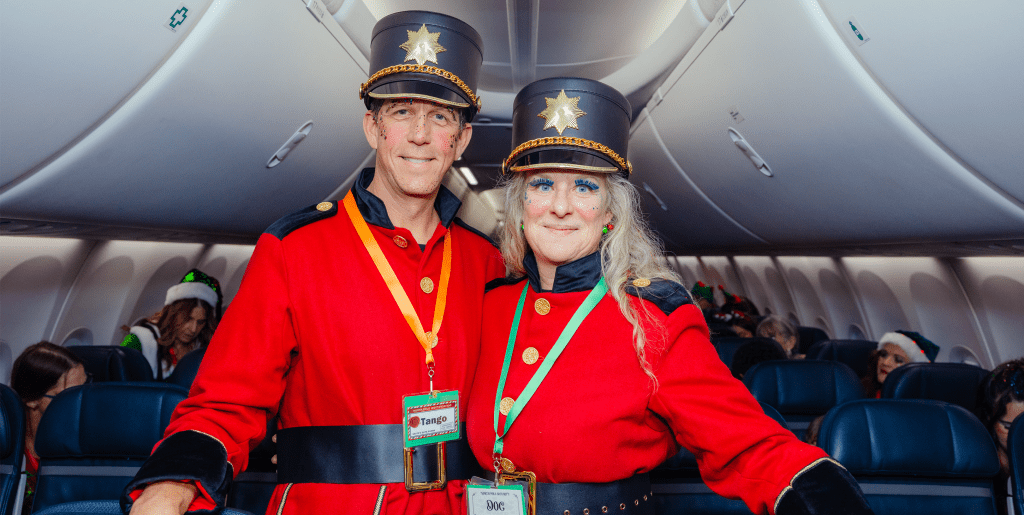
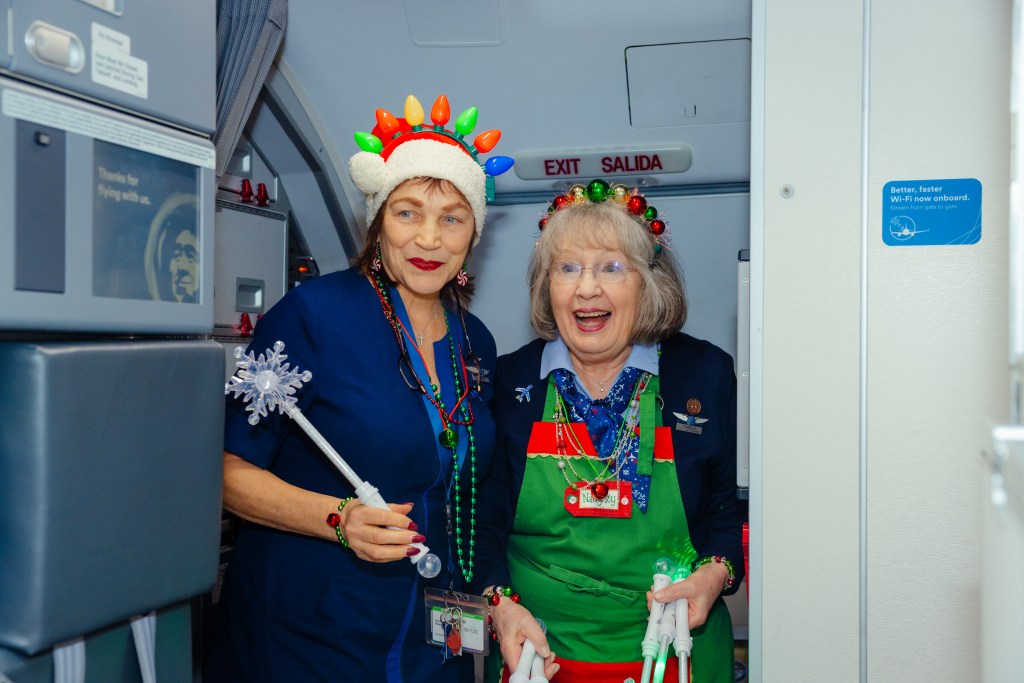
As the countdown to Christmas begins, Alaska Airlines turned up the holiday cheer by partnering with Northwest North Pole Adventures to transform an ordinary flight into an unforgettable experience for children in need.

Last Saturday, 43 well-deserving kids from shelters and transitional housing spent a magical evening alongside more than 200 volunteer elves on a special journey to the North Pole.

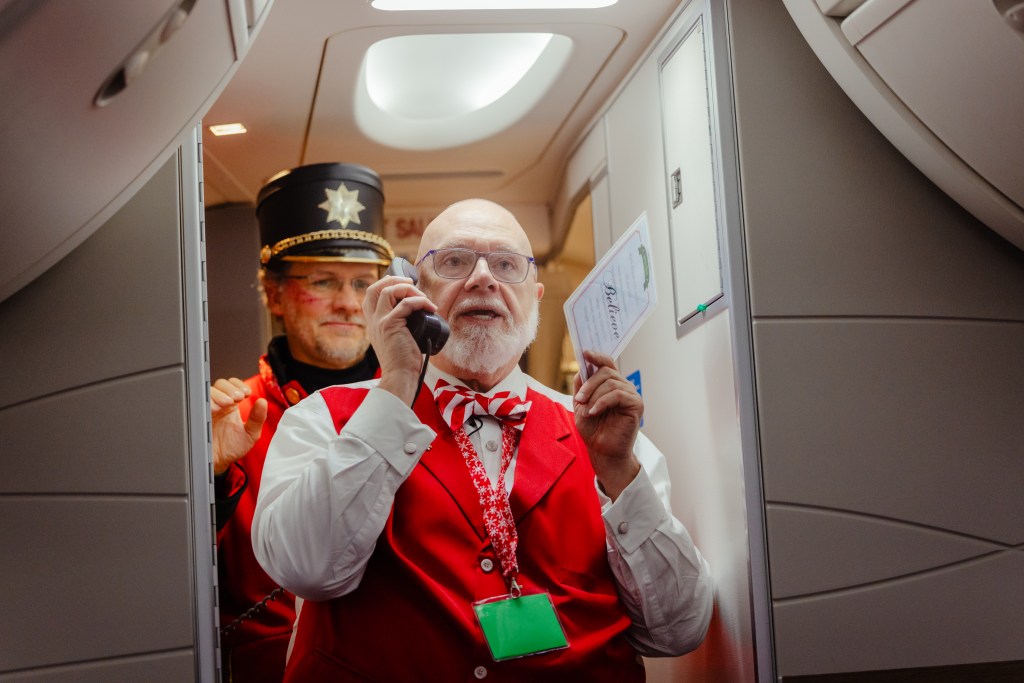
For most of these children, Flight AS 1225 — our festive nod to Dec. 25 — was their very first time flying. The Boeing 737 departed Spokane, Wash., with six of our crewmembers and one mission: deliver smiles and holiday joy during a 40-minute nonstop trip to Santa’s hometown.

While airborne, the festivities soared as the kids and their chaperone elves sang carols, played games, shared stories and recited the magical chant that would allow the aircraft to enter Santa’s airspace.

When the plane touched down at the North Pole — a hangar at Spokane International Airport transformed into a winter wonderland — the children stepped into a fantastical world of glittering lights and decorations, cheerful activities, sparkly face painting and endless holiday treats.

Santa and Mrs. Claus made a grand entrance, greeting each child with a warm smile and a gift from their wish list, ready to make holiday dreams come true.

Elf coming out of an Alaska Airlines aircraft
The North Pole at Spokane
Mrs. Claus with child

Since 2008, we’ve partnered with Northwest North Pole Adventures to make this event possible. Each year, our employees and community volunteers donate their time, energy and Christmas spirit, while local businesses contribute everything from decorations to toys. For all of us at Alaska, Fantasy Flight is more than a holiday tradition — it’s a shared experience that shows the greatest magic isn’t in the flight itself, but in the hearts that make it possible.

More moments from our Fantasy Flight to the North Pole

Hawaiian and Alaska airlines, Par Hawaii and Pono Energy partner to advance the Hawai‘i-based market, supply chain for sustainable aviation fuel production  

Alaska and Hawaiian aircraft tails featured image

Summary

The combined airlines will take the first deliveries of Hawaiʻi-made SAF in early 2026.

The investment enables SAF production for more sustainable future flying, diversifies Hawaii’s fuels industry, strengthens energy independence and supports agriculture.

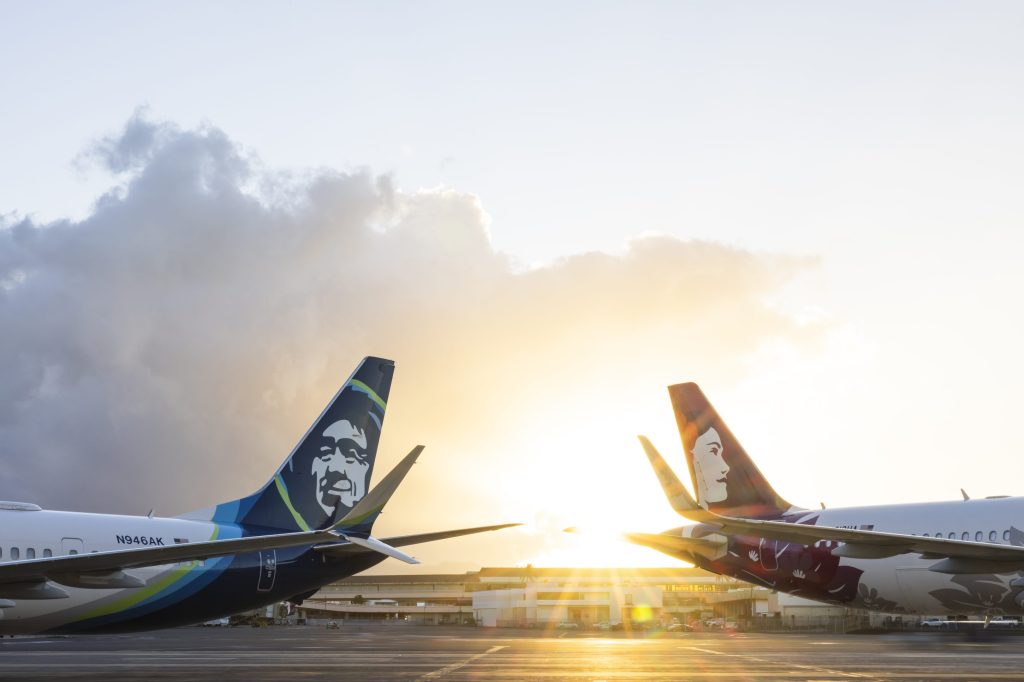
Hawaiian Airlines and Alaska Airlines today announced it has joined Par Hawaii to invest in pioneering the development of sustainable aviation fuel (SAF) in Hawaiʻi using locally grown agriculture feedstock to reduce aviation carbon emissions.

This initiative will enable SAF production for more sustainable future flying and deliver economic benefits through the creation of a new energy sector and fuel supply chain in Hawai’i, while bringing new opportunities for local agriculture.

Hawaiian Airlines and Alaska Airlines, which together provide the most flights to, from and within Hawai‘i, and Par Hawaii, the largest producer of energy products in the islands, are partnering with Pono Pacific, through its Pono Energy, Inc. subsidiary, to study Camelina sativa (camelina) as a multi-purpose crop that can be used as SAF feedstock and to support agriculture.

Hawaii agricultural field

The combined airlines also will become Par Hawaii’s launch SAF customer, with plans to take delivery of Hawaiʻi’s first locally produced SAF in the first quarter of 2026. 

SAF, a safe drop-in fuel made from sustainable feedstock such as plant-based oils or used cooking oil, can cut lifecycle carbon emissions by up to 80 percent compared to conventional jet fuel. Pono Pacific’s crop trials drew the attention of Alaska Star Ventures, the venture capital arm of Alaska Air Group that invests in technologies to drive aviation efficiency, performance and innovation. 

As Hawaiʻi’s airline, we have a responsibility to reduce our environmental impact while continuing to provide essential air service that connects our communities and strengthens our economy. Our company has a long-term strategy to reach net zero carbon emissions, and sustainable aviation fuel is essential for us to get there. We are grateful to have partners like Par Hawaii and Pono Pacific who share our commitment to making our operations more sustainable while creating a new fuel industry and strengthening Hawaiʻi’s energy independence.”

Alanna James

Sustainability innovation director, Hawaiian Airlines and Alaska Airlines

We value the efforts of our airline partners as we work together to find long-term solutions to reduce greenhouse gas emissions and increase our energy security, while meeting Hawai‘i’s transportation needs. We applaud Hawaiian and Alaska airlines, Par Hawaii, and Pono Pacific for taking this important step to establish a locally based, lower-emissions supply chain for aviation fuel that supports our state’s clean energy goals.”

Ed Sniffen

Director, Hawai‘i State Department of Transportation

Pono Pacific, the state’s largest private resource company, will launch Pono Energy, Inc. in early 2026 to accelerate its work on camelina, a high-yield, pest-resistant cover crop that can be grown in rotation with food crops, reaching maturity in just eight to nine weeks. Its oil seeds can be crushed to produce renewable fuels, including SAF, while the remaining seedcake can be turned into government-approved, nutrient-rich feed for cattle and chickens. This revenue-generating cover crop will deliver more economic opportunity for Hawai‘i by creating jobs, supporting farmers and decreasing the aviation industry’s carbon footprint. 

Seedling photo
Seeds photo
Test crops in Hawaii

Camelina represents a rare opportunity for Hawai‘i to build a true circular-economy model around renewable fuels. By growing this crop locally, we strengthen our agricultural sector, keep more dollars circulating within the state, and reduce our dependence on imported fossil fuels. Camelina can be refined into sustainable aviation fuel while the remaining seedcake becomes a valuable, locally produced animal feed that supports Hawai‘i’s ranchers and livestock industry. We will explore food crops that can be grown alongside camelina to increase food security as well. It’s a win for our economy, a win for local agriculture, and a win for the environment — an example of how Hawai‘i can lead the way in innovative, homegrown climate solutions.”  

Chris Bennett

Vice president of sustainable energy solutions, Pono Pacific Land Management, LLC

Alaska Star Ventures has made a new investment that builds on Par Hawaii’s earlier support of Pono Pacific, which collaborated with the Hawaiʻi Agriculture Research Center to begin cultivating 50 non-GMO camelina varieties in 2023 to identify those best suited to Hawaiʻi’s year-round temperate climate. 
 
The initial investment allowed Pono Pacific to conduct crop trials on four islands, in partnership with Aloun Farms, Mahi Pono and Meadow Gold Dairy. Pono Pacific identified suitable agricultural lands across the state and engaged Hawai‘i’s cattle and livestock industry to explore the use of camelina seedcake as animal feed.  
 
As Pono Pacific advances the agricultural foundation for camelina, Par Hawaii, the state largest fuels manufacturer, is preparing to deliver SAF in the first quarter of 2026. Earlier this year, Par Pacific, parent company of Par Hawaii, formed Hawai‘i Renewables, and partnered with Alohi Renewable Energy, LLC, a joint venture between Mitsubishi Corporation and ENEOS Corporation, following a $100 million investment to convert and upgrade one of the refinery’s processing units into a renewable hydrotreater capable of processing plant-based and waste oils.  

Fuel gauge

In 2022, when we formed an agreement with Hawaiian Airlines to jointly study the commercial viability of locally produced sustainable aviation fuels, we didn’t think we would be able to progress so quickly. With renewable fuel production coming online in early 2026, it’s exciting to see the results of our team’s hard work. These fuels will have up to 80 percent lower carbon emissions compared to conventional fuels. This would not have been possible without a shared vision for our islands and our great teamwork.”

President

Eric Wright, Par Hawaii

We are thrilled to be the first customer to receive SAF from Par Hawaii next year,” added James.

“This is an important milestone for our company and Hawai’i, but there is still more work to do. While SAF is the best option to reduce aviation emissions, it is two to three times more expensive than regular jet fuel and supply is limited. We will need strong collaboration across airlines, fuel and feedstock producers, investors, including business partners seeking to offset their scope 3 emissions, and government, along with supportive policies, to grow the SAF industry and reach our decarbonization goals. 

About Alaska Air Group

Alaska Airlines, Hawaiian Airlines and Horizon Air are subsidiaries of Alaska Air Group, and McGee Air Services is a subsidiary of Alaska Airlines. We are a global airline with hubs in Seattle, Honolulu, Portland, Anchorage, Los Angeles, San Diego and San Francisco. We deliver remarkable care as we fly our guests to more than 140 destinations throughout North America, Latin America, Asia and the Pacific. We’ll serve Europe beginning in spring 2026. Guests can book travel at alaskaair.com and hawaiianairlines.com. Alaska is a member of the oneworld alliance, with Hawaiian scheduled to join oneworld in spring 2026. With oneworld and our additional global partners, guests can earn and redeem points for travel to over 1,000 worldwide destinations with Atmos Rewards. Learn more about what’s happening at Alaska and Hawaiian at news.alaskaair.com. Alaska Air Group is traded on the New York Stock Exchange (NYSE) as “ALK.”

About Par Hawaii 
Par Hawaii is the state’s leading provider of transportation fuels. It is headquartered in Honolulu and is a wholly-owned subsidiary of Houston, Texas-based Par Pacific Holdings, Inc. [NYSE: PARR]. Par Hawaii owns the state’s only petroleum refinery in Kapolei, Oʻahu, and has invested $100 million to reconfigure one of the refinery’s processing units to produce renewable fuels from plant-based and waste oils. Par Hawaii’s statewide fuel distribution system includes pipelines on Oʻahu and storage facilities on all major neighbor islands. It markets gasoline, diesel, and biodiesel through its network of 76 and Hele retail stations throughout Hawaii, and operates the Hele convenience stores. Visit www.ParHawaii.com. 

About Pono Pacific 

Pono Pacific Land Management, LLC (Pono Pacific), is Hawai‘i’s largest private natural resource conservation company and works with state and federal agencies, nonprofit organizations, and education institutions to protect and restore sensitive ecosystems and indigenous species. Pono Pacific has supported the management of land and watersheds on O‘ahu, Kaua‘i, Moloka‘i, Lāna‘i and Maui, and has restored and managed a variety of ecosystems statewide. Pono has developed agricultural projects and supported energy feedstock projects throughout Hawai‘i. The company’s mission is rooted in the Hawaiian word “pono”—doing what is right and living with integrity. Its sister companies, Pono Island Capital and Poukihi, are the building blocks to sustain life and uplift Hawai‘i’s economy and community while restoring natural resources. 



Loading...